
Webinar: How to upgrade your OpenStack cloud easily, without downtime

Alexia Emmanoulopoulou
on 28 June 2017
Tags: cloud , containers , OpenStack , spotlight , stuckstack , update , webinar
Live webinar
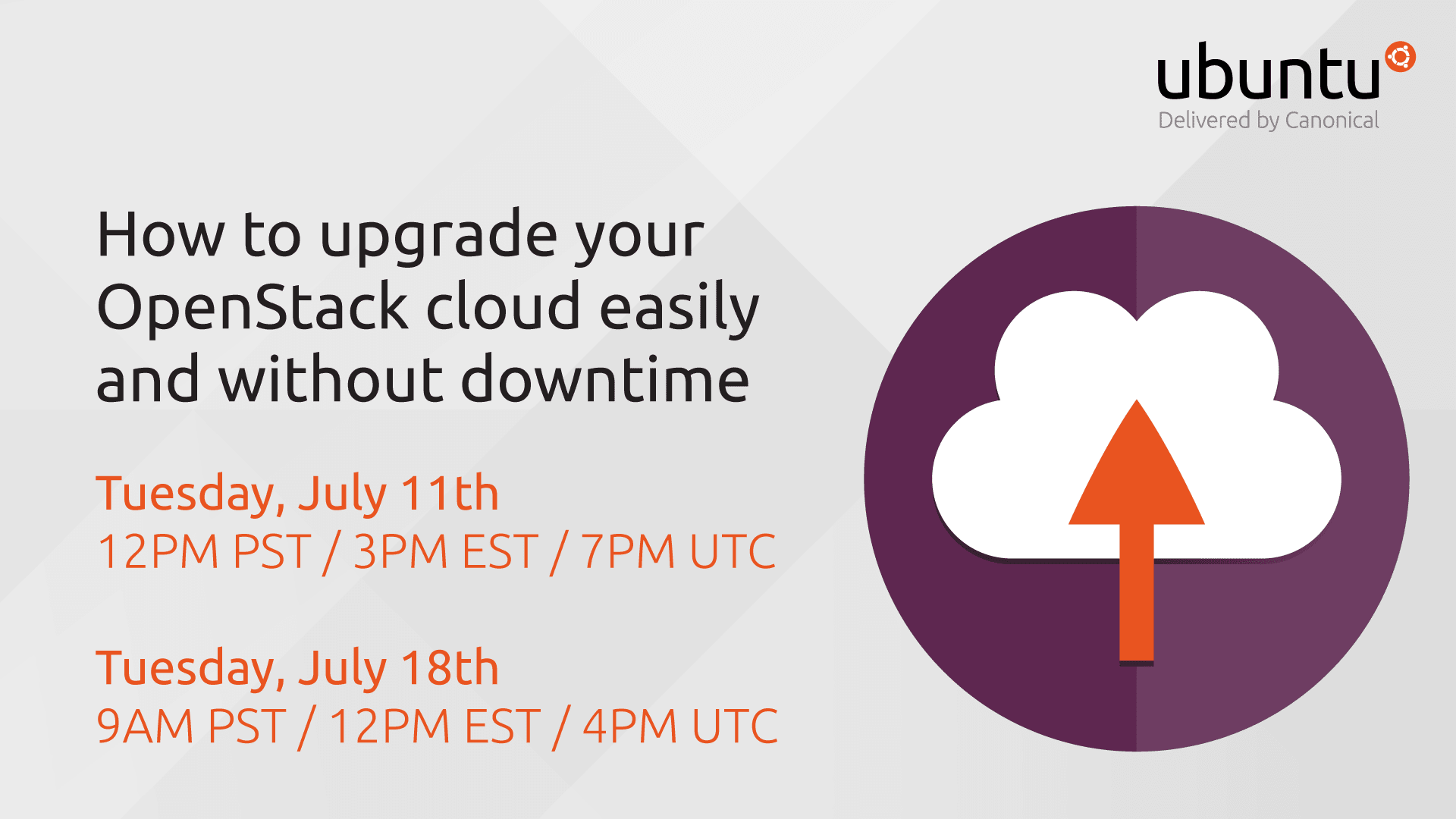
It has become commonplace to see some OpenStack users choose to remain on old unsupported versions of OpenStack, forgoing new features and security updates rather than face the disruption, stress and complexity of upgrading. At Canonical we call this a StuckStack, a cloud that cannot or will not be upgraded.
In this webinar we will show you how to get unstuck and onto an OpenStack path where upgrades between releases are guaranteed. Access to compelling new features in OpenStack becomes easy as systems can be upgraded with little or no downtime.
Register for webinar
11 July | 18 July | on-demand
3 things you’ll learn
- How to migrate to an OpenStack cloud with guaranteed upgrades between release
- Why are upgrades easy with Canonical OpenStack?
- What you need to do to get your Stack unstuck, through a live demo of an upgrade from Newton to Ocata
This webinar will includes a live demo and Q&A.
Speaker
Mark Baker, OpenStack Product Manager, Canonical
Smart operations, optimal architecture, better pricing.
OpenStack and Ubuntu bring automated deployment and management that help you optimize infrastructure costs — no matter your industry or use case.
Newsletter signup
Related posts
Join Canonical at the first-ever African OpenInfra Days
For the second time, and in less than one month, Canonical is coming to East Africa! Three weeks ago, we had the first-ever UbuCon Africa, which was...
Canonical partners with Snyk for scanning chiseled Ubuntu containers
Canonical, the publisher of Ubuntu, is pleased to announce a new partnership with developer-focused cybersecurity company Snyk. Snyk Container, Snyk’s...
How to set up a micro lab: four principles for a reliable homelab
After over a decade of running a homelab, I have learned a few difficult lessons. Although it begins as a “lab,” you inevitably end up with something you want...